Skip to content

The Lindy Library

Ideas filtered by the harshest critic: time.

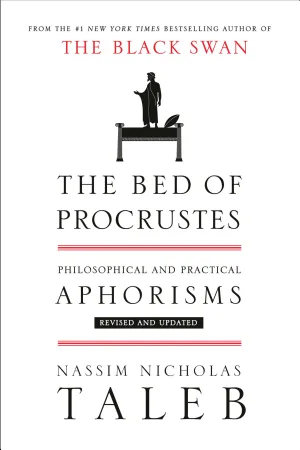
Cover of The Bed of Procrustes
Nassim Nicholas Taleb·2010

The Bed of Procrustes

A collection of philosophical aphorisms exploring antifragility, uncertainty, ethics, and the human tendency to force reality to fit our models rather than the other way around.

Cover of The Symposium
Plato·385 BC

The Symposium

A series of speeches on the nature of love, culminating in Socrates' account of his conversation with the wise woman Diotima.

Cover of The Feynman Lectures on Physics
Richard P. Feynman·1964

The Feynman Lectures on Physics

The transcribed lectures of the Nobel laureate physicist at Caltech, 1961–1963. The most beloved physics text ever written.

Cover of The Book of Chuang Tzu
Zhuangzi·300 BC

The Book of Chuang Tzu

The second great text of Taoism, written by the philosopher Zhuangzi around the 4th century BC. Full of parables, paradoxes, and dark humour, it challenges conventional notions of knowledge, morality, and the boundaries between life and death.

Cover of Anna Karenina
Leo Tolstoy·1878

Anna Karenina

The tragic story of a married aristocrat and her affair, set against the backdrop of Russian society. Tolstoy's most structurally perfect novel.

Cover of The Republic
Plato·375 BC

The Republic

Plato's foundational dialogue on justice, the ideal city-state, and the philosopher-king. The most influential work in the history of Western political philosophy.

Cover of The Odyssey
Homer·800 BC

The Odyssey

Odysseus's ten-year journey home from Troy. The founding myth of the Western adventure narrative and of homecoming.

Cover of Utilitarianism
John Stuart Mill·1863

Utilitarianism

In five compact essays, Mill refines and defends the utilitarian principle — that actions are right insofar as they promote happiness, wrong insofar as they produce the reverse. Mill's crucial contribution is the distinction between higher and lower pleasures: the happiness of a human being is not the happiness of a pig. The most readable and enduring defense of consequentialist ethics.

Cover of The Prince
Niccolò Machiavelli·1532

The Prince

A political treatise on how a ruler should acquire and maintain political power. The foundational text of modern political science.

Cover of Capitalism and Freedom
Milton Friedman·1962

Capitalism and Freedom

Friedman's argument for economic freedom as the foundation of political freedom. Introduced the negative income tax and school vouchers.

Cover of Letters from a Stoic
Seneca·65

Letters from a Stoic

One hundred and twenty-four letters written by Seneca to his friend Lucilius, covering friendship, death, time, wealth, and the examined life.

Cover of The General Theory of Employment, Interest and Money
John Maynard Keynes·1936

The General Theory of Employment, Interest and Money

The founding text of macroeconomics, arguing for government intervention to manage economic cycles.

Cover of Beyond Good and Evil
Friedrich Nietzsche·1886

Beyond Good and Evil

Nietzsche's critique of past philosophers and democratic morality. A prelude to his philosophy of will to power and the revaluation of all values.

Cover of Essays
Michel de Montaigne·1580

Essays

Montaigne's collection of personal reflections on everything from cannibals to experience. The inventor of the essay form.

Cover of Summa Theologica
Thomas Aquinas·1274

Summa Theologica

The encyclopedic synthesis of Aristotelian philosophy and Christian theology. The greatest and most systematic work of medieval philosophy.

Cover of Surely You're Joking, Mr. Feynman!
Richard P. Feynman·1985

Surely You're Joking, Mr. Feynman!

The adventures of the unconventional Nobel Prize-winning physicist. The most entertaining scientific memoir ever written.

Cover of Lives
Plutarch·100

Lives

Forty-eight biographies arranged in pairs — a Greek life alongside a Roman counterpart — followed by a comparison of the two. Plutarch was not writing history but moral philosophy in the form of biography: his subjects are chosen and their lives narrated to illuminate virtue and vice in action. Alexander alongside Caesar. Demosthenes alongside Cicero. Brutus alongside Dion.

Cover of Les Misérables
Victor Hugo·1862

Les Misérables

Set in post-Napoleonic France, Les Misérables follows the ex-convict Jean Valjean across three decades as he reinvents himself while being pursued by the relentless Inspector Javert. Through its intricate web of characters Hugo constructs a moral universe in which justice and mercy are perpetually in conflict.

Cover of Treasure Island
Robert Louis Stevenson·1883

Treasure Island

Young Jim Hawkins discovers a treasure map, joins a ship's crew that includes the duplicitous Long John Silver, and sails to an island of gold and treachery. Written initially to entertain a child, Treasure Island became the defining template of the adventure novel: morally complex pirates, shifting loyalties, and the ambiguity of courage and greed in close quarters.

Cover of On Liberty
John Stuart Mill·1859

On Liberty

Mill's defence of individual freedom against social and governmental tyranny. The foundational text of classical liberalism.

Cover of Nicomachean Ethics
Aristotle·340 BC

Nicomachean Ethics

Aristotle's foundational treatise on virtue, happiness (eudaimonia), and the good life. The foundation of Western moral philosophy.

Cover of Siddhartha
Hermann Hesse·1922

Siddhartha

The spiritual journey of a young Indian man who abandons wealth and pleasure in search of enlightenment. One of the most read and beloved novels of spiritual seeking in the Western world.

Cover of Don Quixote
Miguel de Cervantes·1605

Don Quixote

The adventures of an idealistic knight who confuses fiction with reality. Widely considered the first modern novel.

Cover of The Black Swan
Nassim Nicholas Taleb·2007

The Black Swan

Taleb's analysis of rare, high-impact events and our tendency to explain them after the fact. A fundamental challenge to how we think about risk and prediction.

Cover of Philosophical Investigations
Ludwig Wittgenstein·1953

Philosophical Investigations

Wittgenstein's late masterwork, dismantling centuries of philosophical confusion by tracing how language actually works in everyday use. His own repudiation of the Tractatus.

Cover of The Road to Serfdom
Friedrich Hayek·1944

The Road to Serfdom

Hayek's warning that central economic planning inevitably leads to political tyranny. Written during WWII, it became the intellectual foundation of free-market conservatism.

Cover of The Enchiridion
Epictetus·135

The Enchiridion

A concise manual of Stoic philosophy by the freed slave turned philosopher. Contains the Stoic dichotomy of control in its clearest form.

Cover of Two Treatises of Government
John Locke·1689

Two Treatises of Government

Locke's argument for natural rights, government by consent, and the right of revolution. The intellectual foundation of liberal democracy.

Cover of Who We Are and How We Got Here
David Reich·2018

Who We Are and How We Got Here

A landmark account of the ancient DNA revolution, revealing how the analysis of prehistoric human genomes has overturned our understanding of human migration, mixture, and prehistory.

Cover of Democracy in America
Alexis de Tocqueville·1835

Democracy in America

After traveling through the United States for nine months in 1831, the 26-year-old Frenchman Tocqueville produced what may be the most prescient book ever written about America. He analyzed democracy not just as a political system but as a social condition, predicting with astonishing accuracy its tendencies: the tyranny of the majority, the flattening of distinction, the restless materialism, and the vulnerability to a soft despotism.

Cover of The History of the Peloponnesian War
Thucydides·431 BC

The History of the Peloponnesian War

The definitive account of the war between Athens and Sparta. The founding text of Western historiography and political realism.

Cover of The Apology of Socrates
Plato·399 BC

The Apology of Socrates

Plato's account of Socrates' trial and defence before the Athenian jury. The founding document of the Western ideal that one must follow reason even at the cost of one's life.

Cover of Man's Search for Meaning
Viktor Frankl·1946

Man's Search for Meaning

Frankl's account of surviving the Nazi death camps and the development of logotherapy. One of the most impactful books of the 20th century.

Cover of Moby-Dick
Herman Melville·1851

Moby-Dick

The obsessive hunt of Captain Ahab for the white whale. America's national epic and one of the most ambitious novels in any language.

Cover of Nineteen Eighty-Four
George Orwell·1949

Nineteen Eighty-Four

Orwell's dystopian vision of a totalitarian surveillance state. The most politically influential novel of the 20th century.

Cover of The Dao of Capital
Mark Spitznagel·2013

The Dao of Capital

Spitznagel's synthesis of Austrian economics, Taoist philosophy, and investing strategy. Argues for the "roundabout" — taking an indirect path to outsized long-term gains by prioritising intermediate positions over immediate profit.

Cover of Animal Farm
George Orwell·1945

Animal Farm

An allegorical novella about a farm animal revolution that mirrors the corruptions of the Soviet revolution.

Cover of Essays and Aphorisms
Arthur Schopenhauer·1851

Essays and Aphorisms

Drawn from Parerga and Paralipomena, this collection of essays and maxims is Schopenhauer at his most readable — on suffering, boredom, solitude, the will, the consolations of art, and the wisdom of silence. It is what made him famous in his lifetime, and what Nietzsche, Tolstoy, and Borges all read in their formative years.


Cover of Politics
Aristotle·335 BC

Politics

Aristotle examines the constitutions of 158 city-states to develop a comprehensive theory of government. His central question — what kind of constitution produces a good life for its citizens? — has grounded every serious discussion of political philosophy since. The companion to the Nicomachean Ethics: if the Ethics asks how an individual should live, the Politics asks how we should live together.

Cover of The Story of Civilisation
Will Durant and Ariel Durant·1935

The Story of Civilisation

Eleven volumes covering the whole sweep of human civilisation from ancient India and China to Napoleon. The most ambitious work of narrative history in the English language.

Cover of Seeking Wisdom: From Darwin to Munger
Peter Bevelin·2003

Seeking Wisdom: From Darwin to Munger

A deeply researched compendium of mental models, cognitive biases, and wisdom drawn from Darwin, Munger, Buffett, Feynman, and the psychological literature. A manual for better thinking.

Cover of The Count of Monte Cristo
Alexandre Dumas·1844

The Count of Monte Cristo

The story of Edmond Dantès — wrongly imprisoned, improbably escaped, and elaborately revenged. The greatest adventure novel and the most sustained meditation on justice ever written in popular fiction.

Cover of War and Peace
Leo Tolstoy·1869

War and Peace

Tolstoy's panoramic novel of Russian society during the Napoleonic Wars. Generally considered one of the greatest novels ever written.

Cover of Thinking, Fast and Slow
Daniel Kahneman·2011

Thinking, Fast and Slow

Kahneman's summary of a lifetime of research on the two systems of human cognition and their implications for judgment and decision-making.

Cover of The Open Society and Its Enemies
Karl Popper·1945

The Open Society and Its Enemies

Popper's wartime defence of liberal democracy against the totalitarian philosophies he traced to Plato, Hegel, and Marx. The most rigorous philosophical argument for open institutions ever written.

Cover of The Problems of Philosophy
Bertrand Russell·1912

The Problems of Philosophy

Russell's concise introduction to the central problems of epistemology and metaphysics. The clearest gateway to serious philosophy ever written.

Cover of The Code of Hammurabi
Hammurabi of Babylon·1754 BC

The Code of Hammurabi

The most complete surviving legal code of the ancient world, inscribed on a black stone stele by the Babylonian king Hammurabi around 1754 BC. Its 282 laws govern commerce, labor, property, family, and criminal justice — including the earliest known articulation of proportional punishment. It represents the first attempt to systematize law into a coherent, publicly visible code.

Cover of Discourses
Epictetus·108

Discourses

The extended teachings of Epictetus, recorded by his student Arrian. More detailed than the Enchiridion, covering Stoic physics, ethics, and logic.

Cover of One Hundred Years of Solitude
Gabriel García Márquez·1967

One Hundred Years of Solitude

The multigenerational story of the Buendía family in the fictional town of Macondo. The defining work of magical realism.

Cover of The Art of War
Sun Tzu·500 BC

The Art of War

The ancient Chinese military treatise on strategy, tactics, and leadership. The most influential work on strategy in the Asian military tradition.

Cover of The Annals
Tacitus·117

The Annals

Tacitus's history of the Roman Empire from Augustus to Nero. Celebrated for its psychological depth and moral seriousness.

Cover of Human Action
Ludwig von Mises·1949

Human Action

Mises' comprehensive treatise on economics from the Austrian School perspective. The most rigorous systematic exposition of free-market economic theory.

Cover of De Beneficiis
Seneca·64

De Beneficiis

Seneca's seven-book treatise on the nature of giving and gratitude — one of the deepest investigations into obligation, generosity, and the social fabric of human life in antiquity.

Cover of The Trial
Franz Kafka·1925

The Trial

Josef K. is arrested and prosecuted by an inaccessible authority for an unspecified crime. The foundational text of existentialist fiction.

Cover of The Decline and Fall of the Roman Empire
Edward Gibbon·1776

The Decline and Fall of the Roman Empire

The greatest work of historical narrative in the English language. Covers Rome's history from the 2nd century AD through the fall of Constantinople in 1453.

Cover of The Metamorphosis
Franz Kafka·1915

The Metamorphosis

A travelling salesman wakes to find himself transformed into a monstrous insect. In sixty pages, Kafka captured alienation, family obligation, and the absurdity of modern life more completely than most novelists manage in six hundred.

Cover of On the Nature of Things
Lucretius·55 BC

On the Nature of Things

An epic poem explaining Epicurean philosophy and the atomic theory of matter. Argues for a universe without divine intervention or fear of death.

Cover of The Art of War II
Sun Bin·350 BC

The Art of War II

The lost sequel to Sun Tzu's Art of War, written by his descendant and fellow strategist Sun Bin. Rediscovered in 1972 after two millennia buried in a Han dynasty tomb, it extends and refines Sun Tzu's principles with hard-won lessons from actual battlefield command — covering troop formations, terrain, the psychology of command, and the art of adapting strategy to circumstances.

Cover of The Bible
Various Authors·1000 BC

The Bible

The foundational sacred text of Christianity and the most widely distributed book in human history. A collection of texts spanning centuries — poetry, history, prophecy, and wisdom — that has shaped Western civilisation more profoundly than any other work.

Cover of Robinson Crusoe
Daniel Defoe·1719

Robinson Crusoe

Shipwrecked on an island for 28 years, Robinson Crusoe reconstructs civilization from scratch — building shelter, growing food, domesticating animals, and eventually rescuing a man he names Friday. The first English novel, it is simultaneously an adventure story, a Protestant meditation on providence and self-reliance, and a thought experiment about what a human being fundamentally is stripped of society.

Cover of Hamlet
William Shakespeare·1603

Hamlet

Shakespeare's tragedy of the Danish prince who feigns madness while seeking revenge for his father's murder. The most performed play in the Western repertoire.

Cover of The Critique of Pure Reason
Immanuel Kant·1781

The Critique of Pure Reason

Kant's monumental investigation into the nature and limits of human knowledge. One of the most influential and difficult books in the Western philosophical canon.

Cover of Gulliver's Travels
Jonathan Swift·1726

Gulliver's Travels

Lemuel Gulliver's four voyages — to the land of tiny people, the land of giants, the island of philosophers, and the land of rational horses — form the most devastating satirical structure in English literature. What appears to be an adventure story is, on closer reading, a systematic assault on human pride, political corruption, and the self-congratulation of European civilization.

Cover of Atlas Shrugged
Ayn Rand·1957

Atlas Shrugged

Rand's massive philosophical novel set in a dystopian America where the productive class vanishes one by one. A dramatisation of her philosophy of Objectivism: rational self-interest as the highest virtue.

Cover of The Social Contract
Jean-Jacques Rousseau·1762

The Social Contract

Rousseau's theory of popular sovereignty and the general will. The intellectual precursor to the French Revolution.

Cover of The Histories
Herodotus·440 BC

The Histories

The earliest surviving work of historical non-fiction, covering the Persian Wars. Herodotus called the "Father of History."

Cover of The Brothers Karamazov
Fyodor Dostoevsky·1880

The Brothers Karamazov

Dostoevsky's final novel, a murder mystery layered with profound explorations of faith, free will, and the nature of God. Often called the greatest novel ever written.

Cover of The Divine Comedy
Dante Alighieri·1320

The Divine Comedy

Dante's journey through Hell, Purgatory, and Heaven guided by Virgil and then Beatrice. The greatest poem of the medieval world and one of the great works of world literature.

Cover of Principia Mathematica
Isaac Newton·1687

Principia Mathematica

Newton's masterwork presenting the laws of motion and universal gravitation. The founding document of classical physics.

Cover of Relativity: The Special and General Theory
Albert Einstein·1916

Relativity: The Special and General Theory

Einstein's own account of the revolution he had set in motion, written for the educated non-specialist. Few documents in intellectual history are simultaneously as consequential and as readable. The universe described here — curved spacetime, mass-energy equivalence — is the universe we actually inhabit.

Cover of De Officiis
Marcus Tullius Cicero·44 BC

De Officiis

Written in the final months of his life, Cicero's meditation on moral duty draws on Stoic philosophy to define the obligations of citizens, leaders, and friends. The most printed secular book in early modern Europe, it shaped the Renaissance conception of civic virtue and was among the first classical texts Gutenberg printed.

Cover of Cosmos
Carl Sagan·1980

Cosmos

A personal voyage through the universe, from the Big Bang to the search for extraterrestrial intelligence. The companion book to the landmark TV series.

Cover of Thus Spoke Zarathustra
Friedrich Nietzsche·1883

Thus Spoke Zarathustra

Nietzsche's philosophical novel presenting his ideas on the Übermensch, eternal recurrence, and the will to power.

Cover of Metamorphoses
Ovid·8 BC

Metamorphoses

In fifteen books of verse, Ovid retells over 250 mythological tales of transformation — from the creation of the world to the apotheosis of Julius Caesar. No other ancient text has more thoroughly shaped the imagery of Western painting, sculpture, opera, and literature.

Cover of The War of Art
Steven Pressfield·2002

The War of Art

A ruthlessly honest analysis of creative resistance — the internal force that blocks every artist, writer, and entrepreneur from doing their best work — and how to defeat it.

Cover of The Beginning of Infinity
David Deutsch·2011

The Beginning of Infinity

A sweeping argument that all progress — moral, scientific, political, artistic — flows from a single source: the capacity to create explanatory knowledge. Deutsch argues that human understanding is literally infinite in reach, and that the Enlightenment was just the beginning.

Cover of On the Origin of Species
Charles Darwin·1859

On the Origin of Species

Darwin's presentation of the theory of evolution by natural selection. The most important scientific book ever written.

Cover of The Communist Manifesto
Karl Marx and Friedrich Engels·1848

The Communist Manifesto

The political pamphlet commissioned by the Communist League, outlining historical materialism and calling for proletarian revolution.

Cover of The Aeneid
Virgil·19 BC

The Aeneid

Virgil's epic follows Aeneas from the ruins of Troy to the shores of Italy, where his descendants will found Rome. At once a celebration of imperial destiny and a meditation on its cost — the abandoned Dido, the shade of Anchises, the reluctant killing of Turnus — it is the foundational text of Roman literary culture.

Cover of The Tartar Steppe
Dino Buzzati·1940

The Tartar Steppe

A young officer is posted to a remote desert fortress and waits his whole life for an enemy that may never come. A meditation on time, ambition, and the slow tragedy of deferred living.

Cover of Tao Te Ching
Lao Tzu·600 BC

Tao Te Ching

Written in the 6th century BC by Laozi, the Tao Te Ching is the fundamental text of Taoism — a brief, poetic meditation on the nature of existence, leadership, and the art of effortless action. One of the most translated books in existence.

Cover of The Epic of Gilgamesh
Anonymous·2100 BC

The Epic of Gilgamesh

The oldest surviving work of literature in human history, inscribed on clay tablets in ancient Mesopotamia. It follows King Gilgamesh of Uruk and his companion Enkidu through heroic and tragic adventures, culminating in Gilgamesh's confrontation with death and his futile search for immortality. Its themes — friendship, hubris, grief, and the limits of human knowledge — are as immediate now as they were 4,000 years ago.

Cover of The Iliad
Homer·800 BC

The Iliad

The epic poem of the Trojan War, focusing on Achilles' rage and the tragedy of heroic pride. One of the oldest and most influential works in Western literature.

Cover of Genome
Matt Ridley·1999

Genome

A tour of the human genome, one chapter per chromosome, written at the moment the Human Genome Project was completing. The most readable introduction to molecular biology and what the genomic revolution means for medicine, identity, and free will.

Cover of Fooled by Randomness
Nassim Nicholas Taleb·2001

Fooled by Randomness

A book about the hidden role of chance in markets and in life, arguing that we systematically underestimate the impact of randomness while overestimating skill and cause-and-effect narratives.

Cover of Leviathan
Thomas Hobbes·1651

Leviathan

Hobbes' argument for a powerful sovereign to prevent the war of all against all. The founding text of social contract theory.

Cover of The Federalist Papers
Alexander Hamilton, James Madison, and John Jay·1788

The Federalist Papers

A collection of 85 essays written under the pseudonym Publius, urging the ratification of the United States Constitution. Each paper addresses a different aspect of republican government — the dangers of faction, the separation of powers, the structure of the judiciary. The most sustained and sophisticated argument for a specific form of government in the history of political thought.

Cover of Elements
Euclid·300 BC

Elements

The foundational work in geometry, establishing theorems through logical proof. Used as the primary mathematics textbook in the Western world for over 2,000 years.

Cover of Crime and Punishment
Fyodor Dostoevsky·1866

Crime and Punishment

The psychological story of a student who murders a pawnbroker and struggles with guilt. One of the greatest explorations of the criminal mind in literature.

Cover of Strange Case of Dr Jekyll and Mr Hyde
Robert Louis Stevenson·1886

Strange Case of Dr Jekyll and Mr Hyde

The respectable Dr Henry Jekyll develops a formula that separates his good and evil natures into two distinct beings: the refined Jekyll and the brutal Hyde. Written in six days and published in 1886, the novella became one of the most penetrating explorations of the duality of human nature and the illusion of civilized respectability.

Cover of The Analects
Confucius·479 BC

The Analects

The collected sayings and conversations of Confucius, compiled by his disciples after his death. The moral and social framework that has governed East Asian civilisation for 2,500 years.

Cover of The Wealth of Nations
Adam Smith·1776

The Wealth of Nations

The founding text of modern economics, arguing for free markets, the division of labour, and the invisible hand.

Cover of Meditations
Marcus Aurelius·180

Meditations

Personal journal of the Roman Emperor Marcus Aurelius, written as a series of Stoic reflections. One of the most widely read philosophical texts in Western history.


Cover of Confessions
Saint Augustine·397

Confessions

Written as a prayer addressed directly to God, the Confessions traces Augustine's journey from intellectual pride and sensual pleasure to Christian faith. The first great autobiography in Western literature, it probes memory, time, and sin with an honesty that still startles readers sixteen centuries later.

Cover of Ficciones
Jorge Luis Borges·1944

Ficciones

Seventeen short fictions exploring labyrinths, libraries, mirrors, and time — the foundational works of magical realism and a permanent influence on all serious fiction that followed.

Cover of Faust
Johann Wolfgang von Goethe·1808

Faust

Goethe's Faust — composed across sixty years — is the central work of German literature. In it, the scholar Faust wagers with Mephistopheles that the devil cannot find a moment so perfect Faust would wish it to last. What follows traverses human experience from a young woman's love to the foundations of civilization itself.

Cover of The Bhagavad Gita
Vyasa·400 BC

The Bhagavad Gita

Set on the battlefield of Kurukshetra, the Bhagavad Gita is a dialogue between the warrior Arjuna and his charioteer Krishna — who is revealed to be an avatar of Vishnu. As Arjuna hesitates before battle, Krishna teaches him the nature of duty, action without attachment, devotion, and the eternal self. In 700 verses, it addresses the fundamental questions of human existence.

Cover of The Creative Act: A Way of Being
Rick Rubin·2023

The Creative Act: A Way of Being

The legendary music producer's philosophy of creativity — not as a set of techniques but as a fundamental orientation toward the world. A meditation on attention, source, and the nature of making.

Cover of Poor Charlie's Almanack
Charles T. Munger·2005

Poor Charlie's Almanack

The collected wisdom of Charlie Munger — Warren Buffett's long-time partner at Berkshire Hathaway. A masterclass in mental models, multidisciplinary thinking, and rational decision-making from one of the greatest investors and thinkers of the 20th century.

Cover of Antifragile
Nassim Nicholas Taleb·2012

Antifragile

Taleb's framework for things that gain from disorder and volatility. Introduces the concept of antifragility as the opposite of fragility.

Cover of Skin in the Game
Nassim Nicholas Taleb·2018

Skin in the Game

An argument that having personal risk in the outcome of decisions is the foundation of fairness, commercial efficiency, ethics, and the resilience of systems. Without skin in the game, experts and institutions become dangerously detached from consequences.