Skip to content
All Collections
Collection

Politics

The books in this collection have one thing in common: they have survived the most rigorous selection process imaginable — time. These are not books that were hyped when they were published and then forgotten. They are books that generation after generation of readers chose to keep reading, recommending, and building upon. That is the Lindy Effect in action: the longer a book has survived, the longer it is likely to survive.

Cover of The Federalist Papers
Alexander Hamilton, James Madison, and John Jay·1788

The Federalist Papers

A collection of 85 essays written under the pseudonym Publius, urging the ratification of the United States Constitution. Each paper addresses a different aspect of republican government — the dangers of faction, the separation of powers, the structure of the judiciary. The most sustained and sophisticated argument for a specific form of government in the history of political thought.

Cover of Politics
Aristotle·335 BC

Politics

Aristotle examines the constitutions of 158 city-states to develop a comprehensive theory of government. His central question — what kind of constitution produces a good life for its citizens? — has grounded every serious discussion of political philosophy since. The companion to the Nicomachean Ethics: if the Ethics asks how an individual should live, the Politics asks how we should live together.

Cover of The Open Society and Its Enemies
Karl Popper·1945

The Open Society and Its Enemies

Popper's wartime defence of liberal democracy against the totalitarian philosophies he traced to Plato, Hegel, and Marx. The most rigorous philosophical argument for open institutions ever written.

Cover of The Communist Manifesto
Karl Marx and Friedrich Engels·1848

The Communist Manifesto

The political pamphlet commissioned by the Communist League, outlining historical materialism and calling for proletarian revolution.

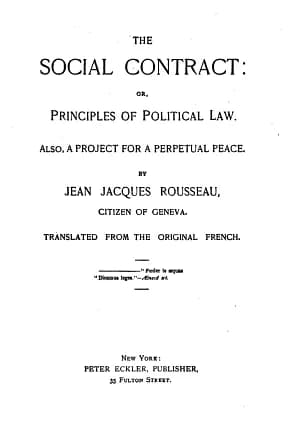
Cover of The Social Contract
Jean-Jacques Rousseau·1762

The Social Contract

Rousseau's theory of popular sovereignty and the general will. The intellectual precursor to the French Revolution.

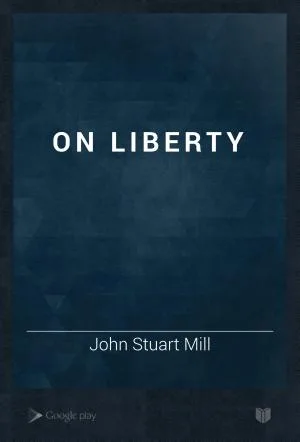
Cover of On Liberty
John Stuart Mill·1859

On Liberty

Mill's defence of individual freedom against social and governmental tyranny. The foundational text of classical liberalism.

Cover of Two Treatises of Government
John Locke·1689

Two Treatises of Government

Locke's argument for natural rights, government by consent, and the right of revolution. The intellectual foundation of liberal democracy.

Cover of Leviathan
Thomas Hobbes·1651

Leviathan

Hobbes' argument for a powerful sovereign to prevent the war of all against all. The founding text of social contract theory.

Cover of Democracy in America
Alexis de Tocqueville·1835

Democracy in America

After traveling through the United States for nine months in 1831, the 26-year-old Frenchman Tocqueville produced what may be the most prescient book ever written about America. He analyzed democracy not just as a political system but as a social condition, predicting with astonishing accuracy its tendencies: the tyranny of the majority, the flattening of distinction, the restless materialism, and the vulnerability to a soft despotism.

Frequently Asked

What is the Lindy Effect?

The Lindy Effect is a concept proposing that the future life expectancy of non-perishable things scales with their current age. A book that has been in print for 200 years is likely to remain in print for another 200 years.

How does The Lindy Library select books?

We select books that have demonstrated enduring value across significant periods of time — generally books that have been continuously read for at least 50 years, and preferably centuries. We prioritize primary sources over summaries, and ideas over trends.